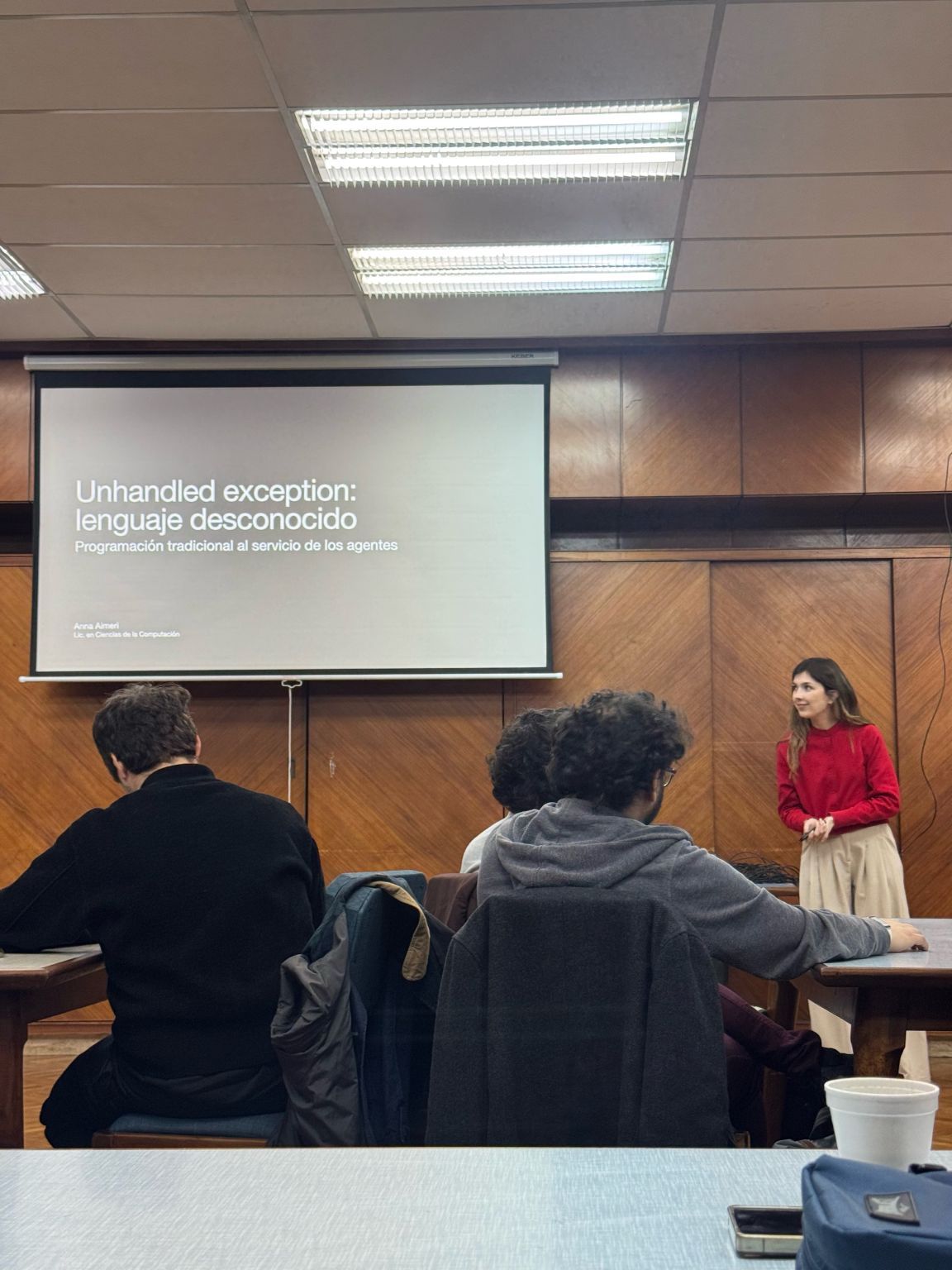
In Unhandled exception: lenguaje desconocido: Programación tradicional al servicio de los agentes, I showed how a parser checks LLM-generated test scenarios.
JAN 2025–PRESENT / NEW YORK, UNITED STATES · REMOTE FROM ARGENTINA
salesElement
Senior Software Engineer & Technical Lead
I lead engineering delivery for .NET systems and client integrations, mentor developers, and work across discovery, architecture, development, and ongoing improvements.
NOV–DEC 2024 / TOKYO, JAPAN
simpleasy inc.
Software Developer · METI internship
I was selected for Japan’s Global South IT/AI Engineer Internship Program, sponsored by the Ministry of Economy, Trade and Industry. I designed and built the Kioku prototype.
JAN 2023–JAN 2025 / CÓRDOBA, ARGENTINA
Sumtech Labs
Software Developer
I built REST APIs and microservices with C#/.NET, ASP.NET Core, and Entity Framework, including work for a U.S. client whose team I later joined. I connected ClickUp and Bitbucket with Python, Flask, and JavaScript, and built an event-ticketing API with Java and Spring Framework that integrated Algorand through its Java SDK.
Education
Universidad Nacional de Córdoba
Bachelor’s Degree in Computer Science (five-year Licenciatura) · March 2026
University Diploma in Computer Science (Analista en Computación) · 2020–2024
English: C2 Proficiency (Grade A) · French: DELF B2
SELECTED WORK02–04
01
Business systems
CRM, accounting, and operations
02
.NET integration
Validate, transform, and route data
03
Connected tools
Sync records so teams don’t have to re-enter them
Example of how records move between systems.
CHAPTER 02 / ENGINEERING LEADERSHIP
Production integrations
C#/.NET integrations for business systems, using Azure, AWS Lambda, and Oracle.
I work directly with U.S. clients to understand their workflows, define requirements, and validate solutions. I design REST APIs and integrations across Zoho, QuickBooks, and Oracle to automate data flows and reduce manual reconciliation. I also build workflows in Zoho CRM and Zoho Desk, including custom automations in Deluge.
I improve the performance and reliability of integrations that teams rely on every day. I lead a distributed engineering team, mentor developers, and modernize .NET Framework applications. I write automated tests, manage CI/CD in Azure DevOps, and monitor systems with Azure Application Insights and AWS CloudWatch.
C# / .NET
Azure Functions
Azure DevOps
REST APIs
Try all three readings
“The cart should reflect the item”
Drag the notebook onto any of the three targets, or select one directly.
Notebook · $10
CartNo items shownNotebookTotal: $0
The notebook appears, but the amount stays the same. The amount changes, but the notebook doesn’t appear. The notebook appears and the total goes up to $10.
All three readings are plausible. Code can check the rules, but it can’t guess which one you meant. Before writing the test, ask what should change.
CHAPTER 03 / THESIS + CODEX
When AI gets the rules wrong
An AI model can give you an answer that sounds right even when it doesn’t know the rules. My thesis looks at what happens when ordinary code checks its work.
Take a test for an online shop. If you add an item and the test says “the cart should reflect it,” should the item appear in the list, should the total change, or both? An AI model can turn that instruction into a test that looks convincing. Software still needs explicit instructions it can check.
I gave the model rules and examples, then used ordinary code to check its output. When the model broke a rule, the checker pointed out exactly where and why so the model could try again. The checker verifies that the output follows the rules. It can’t tell you whether the model picked the meaning you intended.
Technical details
The Python pipeline reads behavior-driven development (BDD) test scenarios from JSON and asks a language model to translate them into an intermediate representation (IBDD). A deterministic Earley parser validates the output against the IBDD grammar. It returns specific errors for a limited number of retries and saves each translation and validation result for analysis.
Kioku (記憶) means “memory” in Japanese. I built this bilingual prototype so people could collect a digital keepsake when they checked in at a live event in Japan.
I owned the architecture, development, and DevOps for the prototype. I designed the PostgreSQL schema, built the API and React interface, and integrated LINE for sign-in and attendance verification. I delivered a live demo and prepared the technical handover.
SIMPLEASY INC. / SELECTED FOR JAPAN’S METI GLOBAL SOUTH IT/AI ENGINEER INTERNSHIP PROGRAM